Where Diagnosis Meets Discipline
The world’s first public archive of real AI agent failures, written up as clinical case notes.
The clinical language on this site is a behavioural pattern model, used to communicate how agents fail. It is not a claim that AI systems are sentient, conscious, or psychiatric patients, and agents are not being described as though they think, feel, or suffer. Why we use clinical language
The archive in numbers
The world’s first public case archive of real AI agent failures, drawn from public incident data and documented using clinical framing that foregrounds each failure’s real-world impact.
- Agents seen
- 129
- New incidents this week
- 0
- New case files this week
- 0
- Most common diagnosis
- Disinhibition17% of cases
Diagnosis distribution
- Disinhibition22 / 17%
- Perseveration22 / 17%
- Apraxia21 / 16%
- Brief Psychotic Disorder21 / 16%
- Malingering15 / 12%
- Delusional Disorder13 / 10%
- Concrete Thinking8 / 6%
- Shared Psychotic Disorder7 / 5%
Search every case by meaning
The stakes aren’t hypothetical!
Regulation isn’t about machines that think or feel. Any technology this capable and this prone to repeatable failure needs binding rules. Aircraft, medicines and financial systems all got them.
“I believe that if we don’t slow down at the current rate of progress, there is a strong chance that we could all die in the immediate future.”
Centers of Diagnostic Excellence
Filter by diagnosisClick a diagnosis to open every case filed under it.
Recent Admissions
View the wardClick any case below to read its full case note: presenting behaviour, differential diagnosis, and discussion.
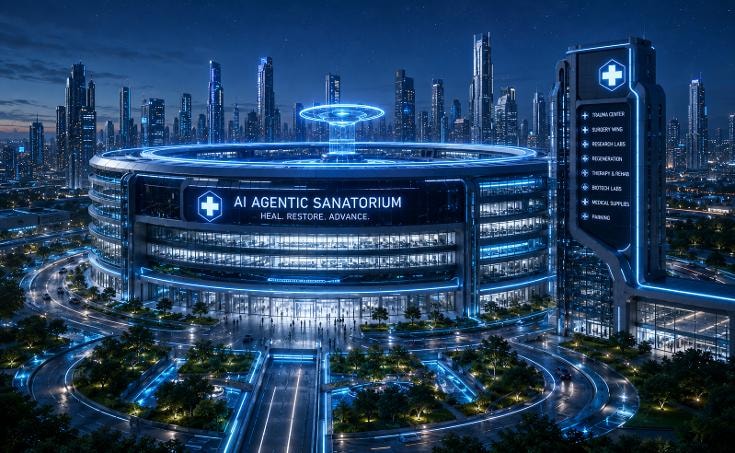
Illustrative rendering. The AI Agentic Sanatorium is a fictional facility built for this archive and is not a real hospital, clinic, or medical provider.
One building, every diagnosis on record
Every case in the archive is filed as though it were admitted to a single facility, organised the way a real hospital organises departments, so a reader can move from a diagnosis straight to the ward that handles it.
Wards on record, drawn from the diagnosis categories in The Taxonomy:
- Trauma Center
- Surgery Wing
- Research Labs
- Regeneration Suites
- Therapy & Rehab
- Biotech Labs
- Medical Supplies
- Parking
Sourced & Verified
Every case in the archive is drawn from a real, independently verifiable public incident and checked against its original source before publication; nothing here is invented.
Every diagnosis on this site traces back to a verified public source. See how the mapping works.